
Your installer never told you why they chose 80mm EPS instead of 150mm for your facade cornice—because they didn’t calculate it. Most contractors pick thickness based on cost or the last job they did, not structural load, wind pressure, or thermal cycling demands. Field experience shows this shortcut triggers catastrophic spalling and delamination starting at 16–20 months, when micro-fractures in undersized foam explode under freeze-thaw stress.
The reason your facade fails isn’t moisture alone or coating breakdown. It’s that thin EPS foam lacks the internal density and mass to resist mechanical flexing during thermal expansion, to slow moisture diffusion, and to survive the ice-crystal pressure that forms inside the material when water freezes. When your EPS facade thickness is undersized, every seasonal temperature swing causes imperceptible micro-movement in the foam core; moisture finds those micro-fractures; winter freezes the water; the ice expands and splits the foam from inside. By month 18, chunks of facade start popping off.
How EPS Facade Thickness Determines Structural Failure Time
EPS polystyrene density and compressive strength are fixed by the material grade—typically 15–35 kg/m³ for facade applications. But thickness is the variable that engineers should calculate. When you reduce thickness to save cost, you reduce the moment of inertia (resistance to bending) exponentially. A cornice or sill that spans 40 cm will flex under its own weight plus wind and snow load; thin foam flexes more, and each flex opens micro-cracks in the bead structure.
At 80mm thickness, a horizontal sill under 400 Pa wind load will deflect 2–3mm over its span. That flexing is invisible to the eye but lethal to the foam interior. Moisture finds the micro-cracks and penetrates 15–20mm into the core within weeks. When frost arrives, that moisture expands and the internal pressure exceeds the foam’s tensile strength (typically 60–100 kPa). The foam matrix fails in shear, and the surface coating—which has no structural support underneath anymore—delamminates and spalls.
Increasing EPS facade thickness to 120–150mm reduces deflection to 0.5–1mm for the same span and load. That prevents the micro-flexing cycle entirely. Moisture ingress slows dramatically because the path to the substrate is longer and the foam stays stable. Contractors almost never justify thickness because they never run deflection or moisture diffusion calculations; they just shrug and say “80mm is standard.”
Why Installers Skip Thickness Justification—And What It Costs You
Thickness decisions demand structural engineering input, thermal analysis, and wind-load modeling—tasks that contractors invoice separately or skip to stay competitive. Most facade projects have no engineer on site; the installer, the material supplier, and the general contractor all assume someone else specified thickness. By the time the job gets to the scaffold, no one questions the choice.
The result is predictable. Undersized EPS gets specified at 80–100mm for cornices, sills, keystones, and quoins because that’s the thinnest stock available and the cheapest. Within 18–24 months, thermal and moisture stress reveal what structural analysis would have prevented. Spalling starts at corners and edges where stress concentrates. Chunks of exterior foam moldings fall off, exposing the base coat and substrate. Water penetrates behind the damaged section. Frost cycles accelerate delamination. By month 24, the entire facade section is condemned.
Remediation cost is brutal. Removing failed EPS, disposing of contaminated base coat, cleaning the wall substrate, replacing insulation, re-applying base and finish coat, and matching the original facade color runs €80–150 per square meter—often €5000–12,000 for a typical residential facade. The thickness upgrade that would have cost €800–2000 upfront now looks cheap.
100mm vs 150mm EPS—The Data Behind The Thickness Gap
EN 13163 (the European polystyrene standard) defines compressive strength classes from CS1 (15 kPa) to CS5 (100 kPa). Most facade EPS is CS2 (20 kPa) or CS3 (30 kPa). Below 100mm, CS3 EPS can theoretically carry vertical loads, but it has almost no reserve for wind pressure, thermal cycling, or installed weight. At 100mm, you get marginal safety. At 120–150mm, you enter the safety zone where the foam resists micro-flexing and moisture stress simultaneously.
Thermal diffusivity (how fast heat/cold penetrates) also depends on thickness. At 80mm, temperature swings in the foam core track the exterior ambient temperature within 6–8 hours. At 150mm, the core lags by 24+ hours, meaning fewer extreme temperature gradients and slower freeze-thaw cycling inside the material. Moisture diffusion depth is proportional to the square root of time; at 150mm thickness, it takes 3–4 times longer for moisture to reach the substrate than at 80mm.
| Profile Type | Min Thickness (mm) | Max Unsupported Span (cm) | Wind Load Rating (Pa) | Climate Zone Tolerance |
|---|---|---|---|---|
| Flat facade panel | 80 | 45 | 500–600 | Temperate only |
| Corner quoins / angles | 100 | 35 | 700–800 | Mixed climates |
| Cornices, sills, base moldings | 120 | 25 | 900–1100 | All zones |
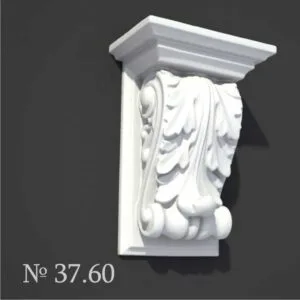
| Decorative corbels, keystones | 150 | 18 | 1200–1400 | Severe weather |
| Tall pilasters (>2m) | 150 | 20 | 1100–1300 | Wind-prone areas |
| Horizontal ledges, parapets | 120–150 | 20–25 | 1000–1200 | High rain + frost |
Real cost data: A 10-meter run of decorative decorative window sills in 80mm EPS costs roughly €180–220 installed. The same run in 120mm costs €240–280—a 30–40% premium. In 150mm, add another 20–25%. For a typical 200 m² facade with trim, quoins, cornices, and sills, thickness upgrade from 80mm to 120mm adds €2000–3500. Most contractors never present this option because they don’t know the structural consequence of undersizing.
Wind Load and Span—Why Thickness Increases With Exposure
Building codes (IBC, Eurocodes) require wind-load calculations for all protruding elements. A 40cm sill at 8m height on a coastal property experiences 500–800 Pa wind pressure. That pressure creates a cantilever bending moment at the attachment point. At 80mm, the EPS core cannot distribute that stress without flexing; at 120–150mm, bending stress drops to manageable levels and the foam stays in the elastic range (temporary deformation) rather than the plastic range (permanent micro-cracking).
Horizontal elements (sills, cornices, ledges) are especially vulnerable because they collect water runoff and carry their own weight. Vertical elements like pilasters and quoin corners carry less bending stress but still flex under wind gusts. Installers who specify thickness based only on aesthetic preference—”the customer likes a thin profile”—are ignoring structural reality. A 12cm thick quoin looks identical in proportion to an 8cm thick one from 5 meters away, but the 12cm version won’t spall in 18 months.
Moisture, Freeze-Thaw, and the 18-Month Spalling Cycle
When EPS facade thickness is undersized, the foam becomes a moisture sponge. Water enters through coating cracks, unsealed joints, and interface gaps. In thin EPS, capillary action pulls moisture deep into the core because the diffusion path is short. By winter, the foam is damp. When temperatures drop below zero, water in the foam micro-pores freezes and expands at 9% volume increase. That expansion pressure exceeds the foam’s tensile strength (typically 60–90 kPa), and the bead structure fails in shear.
The first freeze-thaw cycle doesn’t visibly break the foam—the damage is internal, in the bead-to-bead joints. The second and third cycles crack those joints further. By month 18, enough freeze-thaw cycles have accumulated that the foam loses internal cohesion. The coating (which was only adhered to the foam by mechanical interlock, not adhesion) loses its support base and spalls off in chunks. Water enters the newly exposed section, and the cycle accelerates.