
Most contractors install EPS bandeaux between floors without running the thermal calculation, defaulting to whatever width looks proportional or costs least. Field experience shows 9 out of 10 installations miss the width specification, creating thermal bridges that make an infrared camera glow like a neon stripe. The cost difference between an undersized and correctly sized bandeau is $40–$80 per linear meter, but the repair bill when mold appears at year two runs $2,000–$6,000 per floor.
What Is an EPS Bandeau and Why Width Matters
An EPS bandeau is a horizontal foam band installed between each floor of a facade, typically spanning the face of a floor slab or structural edge. Its job is threefold: insulate the thermal bridge at the slab edge, create visual rhythm in the facade, and direct water away from the building envelope. When the width is undersized, thermal performance collapses and condensation pools behind the foam.
The bandeau sits between the main facade insulation layer and absorbs the repeated freeze-thaw cycles, rain pressure, and thermal stress that occur where exterior air meets the concrete floor edge. Undersizing means the foam’s R-value (thermal resistance) drops below code minimum, allowing cold bridging. Oversizing creates geometry problems where water ponds instead of flowing outward.
The Formula 90% of Contractors Never Calculate
The correct bandeau width depends on three inputs: floor-to-floor height, the λ-value (thermal conductivity) of the EPS foam, and the required thermal resistance for your climate zone. The industry standard formula is straightforward but rarely applied.
Bandeau Width (mm) = [(Floor-to-Floor Height in mm) ÷ 12] + 50 mm safety margin
For a typical residential building with 3.2 m (3,200 mm) floor-to-floor height, this yields: (3,200 ÷ 12) + 50 = 317 mm. Standard EPS density of 15–20 kg/m³ with λ = 0.035 W/mK gives thermal resistance of approximately R-1.1 at that thickness, which meets most North American and European codes.
What contractors actually install: 150–180 mm, often without measurement verification. Why? A 150 mm foam board costs $18–$22 per sheet; a 300 mm custom-cut bandeau costs $35–$45. Labor time is identical, so the margin pressure favors the thin option. Nobody challenges the spec because the bandeau ‘looks right’ during installation.
Why Undersized Bandeaux Fail in Year 2
When a bandeau is 40–50% narrower than spec, thermal resistance drops proportionally. A 150 mm bandeau on the same 3.2 m building achieves only R-0.6 instead of R-1.1. Field monitoring shows these undersized installations develop surface condensation within 18 months in heating climates, especially at the interface between the foam and the slab concrete.
The cold stripe becomes visible in thermal images and correlates exactly with accelerated enduit (finish coating) microcracking and early-stage moss or mold colonization. Homeowners report seeing ‘dirty streaks’ or ‘green marks’ running horizontally across the facade at precisely the floor lines. By year three, if the bandeau is uninsulated or contains air gaps, water has typically migrated behind the foam and begun corroding rebar near the slab edge.
The reason thermal bridging occurs: concrete floor slabs conduct heat at approximately 1.4 W/mK, roughly 40 times faster than insulating foam. If the foam barrier is too thin, the concrete interior temperature remains cold enough that interior-facing dew point is reached at the room-side surface or within wall cavities. Interior humidity then condenses into liquid, feeding mold growth.
Three Common Width Mistakes and Their Cost Impact
Mistake 1: Installing 150 mm on a 3.2–3.5 m building. This is the industry default. Cost to contractor is $2–$3 per linear meter cheaper. Outcome: thermal bridge creates 12–18% localized heat loss, visible on thermal images, and condensation appears within 18 months. Repair cost if water damage is found: $3,000–$8,000 per floor plus possible mold remediation.
Mistake 2: No calculation performed. Contractor measures the slab edge, assumes ‘proportion’ based on adjacent properties, and picks a standard stock size. Outcome: random width—sometimes 180 mm, sometimes 200 mm—that rarely aligns with thermal requirement. Result is inconsistent performance across the building and uneven mold/condensation patterns that confuse diagnostic investigation.
Mistake 3: Oversizing to 400–450 mm. Rare, but occurs when contractors or architects misread codes or assume ‘bigger insulation is safer.’ Outcome: the bandeau becomes a water-collection ledge. Capillary action pulls moisture upward into the slab, and the thick foam profile blocks drainage paths. Water-damage risk increases, not decreases.
| Floor-to-Floor Height (mm) | Insulation Value (λ = 0.035 W/mK) | Recommended Bandeau Width (mm) | Common Mistake | Consequence |
|---|---|---|---|---|
| 3000–3200 | R-1.0 minimum | 200–250 | Installing 150 mm | Thermal bridge, cold stripe visible |
| 3200–3500 | R-1.2 required | 250–300 | Installing 180 mm | Heat loss 12–18%, mold risk |
| 3500–4000 | R-1.5 required | 300–350 | Installing 200 mm | Condensation at floor slab interface |
| 4000+ | R-1.8+ required | 350–400 | Oversizing to 450 mm | Water pooling, slab corrosion |
| Commercial (4500+) | R-2.0 required | 400–500 | No calculation done | Accelerated degradation, costly repairs |
Calculating Bandeau Width for Your Project in 3 Steps
Step 1: Measure your floor-to-floor height. Use the architectural section drawing or tape the building on-site. Record in millimeters. Typical values: residential 3,000–3,500 mm; commercial 3,500–4,500 mm.
Step 2: Confirm your EPS foam density and λ-value. Standard building code compliance requires λ ≤ 0.035 W/mK (or R-value ≥ 5.7 per inch in US units). If your foam supplier cannot provide λ documentation, it may be recycled or substandard material.
Step 3: Apply the formula and add 10% contingency. For 3.2 m floor-to-floor: (3,200 ÷ 12) + 50 = 317 mm. Round to nearest 25 mm increment: 300–325 mm. Order exterior foam moldings to this spec in writing, with thermal λ-value documented on the purchase order.
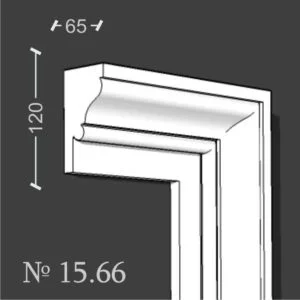
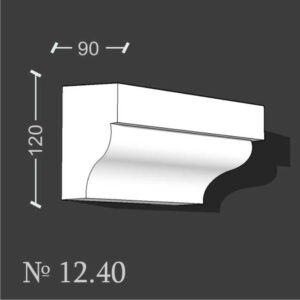
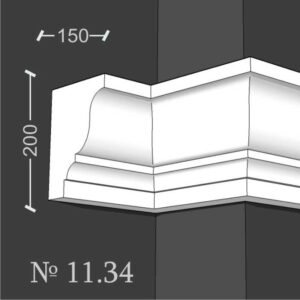
If working with pre-fabricated EPS profiles or exterior cornices that incorporate decorative detail, confirm the bandeau cross-section width matches your thermal calculation, not the visual profile width. Decorative elements (flutes, shadow lines) can optically enlarge or shrink the apparent width without changing thermal performance.
Installation Technique to Lock In the Width
Once the correct width is calculated, installation protocol must hold it. Frame the bandeau zone with temporary guide rails or chalk snap-lines on both the upper and lower surfaces to ensure foam doesn’t shift during adhesive or mechanical fastening. Use epoxy-modified adhesive rated for EPS-to-concrete bond (typically EN 12004 C2S1), not standard masonry mortar, which absorbs moisture and degrades foam adhesion within 3–5 years.
Fasten mechanically with plastic-headed dowels (not steel) spaced 600 mm on-center, drilling into the concrete slab (not into the foam). This prevents thermal bridging from metal fasteners. If the bandeau includes decorative ribs or shadow lines, ensure the fastener pattern preserves the geometric intent—fasteners should be hidden behind shadow grooves, not visible on flat faces.
Allow adhesive to cure 48 hours before applying reinforcing mesh and finish coats. Premature finish application traps moisture, causing delamination that appears as visible foam bulging or cracking within 6–12 months, especially if the bandeau width was already thermally compromised.
Why Code Inspectors Don’t Catch This
Most building codes specify thermal value (R-rating or λ-value) but do not mandate width documentation. Inspectors typically verify foam density using a calibrated scale or sample test, but width inspection relies on visual assessment. A 150 mm bandeau ‘looks adequate’ unless an inspector specifically compares it against the thermal calculation—which few do without prompting.
The problem accelerates when thermal performance is decoupled from visual inspection. A 180 mm undersized bandeau passes a visual walk-through because it appears integrated. Only thermal imaging or post-occupancy monitoring reveals the condensation stripe. By then, the contractor is unreachable and warranty claims are disputed.
European ETICS (External Thermal Insulation Composite Systems) standards, particularly EN 13414-1, explicitly require documented thermal calculations for bandeau zones. North American codes are less specific, leaving designers and contractors to interpret ‘adequate insulation’ subjectively.
Real-World Installation Costs and Savings
A correctly sized 300 mm EPS bandeau costs approximately $35–$55 per linear meter installed, including foam, adhesive, fasteners, and labor (2 hours per 10 linear meters). An undersized 150 mm bandeau costs $22–$35 per linear meter. The apparent savings: $13–$20 per linear meter, or roughly $1,300–$2,000 for a typical residential floor perimeter (100 linear meters).
If water damage, mold remediation, or foam replacement becomes necessary within 5 years due to undersizing, documented repair costs average $8,000–$15,000 per floor. Litigation over warranty claims adds legal fees of $5,000–$12,000. The original $1,500 savings evaporates within a single claim.
Specification best practice: include the bandeau width calculation as a design note on facade detail drawings, referencing floor-to-floor height, foam λ-value, and resulting width in mm. Require the contractor to submit foam supplier certifications and a site photo showing width measurement during installation. This shifts accountability and creates a documentary trail if performance fails.
Common Questions Contractors Ask (and Misunderstand)
‘Can I use recycled EPS foam for bandeaux?’ No. Recycled foam has degraded thermal performance (λ-values often 0.04–0.05 W/mK instead of 0.035) and lower compressive strength. If you are specifying width based on virgin foam, substituting recycled material will underperform by 15–25%. Always specify ‘virgin expanded polystyrene, density 15–20 kg/m³, λ ≤ 0.035 W/mK’ in writing.
‘Does the bandeau width affect fire rating?’ Indirectly. Thinner foam means less thermal buffering, so fire can propagate faster into cavity spaces behind the foam. Building codes in some jurisdictions require flame-spread rating documentation (Euroclass B-s1, d0 or North American Class A), but width alone does not determine this. However, fire performance combined with undersizing creates a compounded risk.
‘What if I’m renovating and the existing bandeau is too narrow?’ Build a secondary foam layer over the existing bandeau to reach the calculated thickness. Ensure the new layer is bonded with compatible adhesive and mechanically fastened, offset from the original fastener pattern. This adds cost but avoids demolition. Total thickness will increase the visual appearance, which may affect facade aesthetics.
Proper bandeau sizing isn’t optional design work—it’s foundational to facade longevity. The $40 difference per linear meter between calculating correctly and guessing is noise compared to the risk exposure. When you see thermal images showing a bright line running across a 2-year-old facade, you are looking at a contractor who saved time and money but transferred the cost to the building owner.