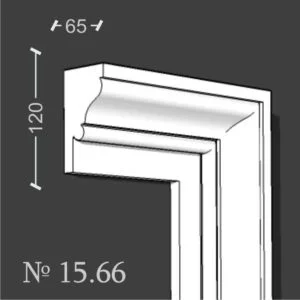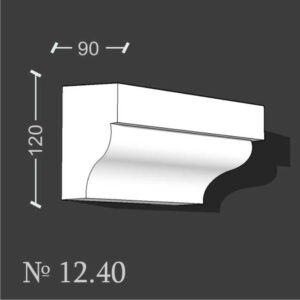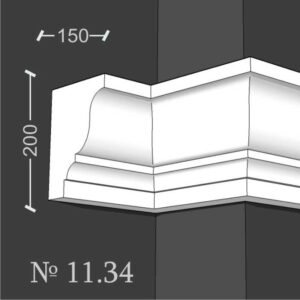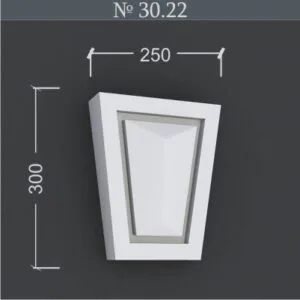
Water infiltration through an EPS corniche (crown molding) kills insulation and substrate in weeks because contractors cut the profile facing the wrong direction or omit the drip edge entirely. A misrouted corniche acts like an open channel, funneling rainfall and wind-driven moisture directly into your wall cavity. By the time you see staining, mold, or foam softening, the damage is already inside the thermal layer, where it hides and spreads.
Why Water Runs Toward the Wall Instead of Away From It
EPS corniche is a horizontal or near-horizontal molding that crowns the top edge of a facade. Its job is twofold: add architectural detail and shed water. The second function depends entirely on geometry—specifically, the angle of the back surface and the presence of a drip edge (a beveled or chamfered cut on the underside).
When a contractor cuts an EPS corniche without routing a downward-angled drip edge, the underside sits flat or even slopes slightly upward toward the wall. Capillary action and gravity then guide water along the adhesive joint and into the substrate behind the molding. In climates with frequent rain or high humidity, this happens within weeks. The water moves laterally into the insulation layer, where it remains trapped, reducing thermal performance and promoting mold growth.
The cost difference between correct and incorrect routing is zero in material. The error is purely procedural: a 2–5 minute operation with a CNC router or a sharp chisel template that saves $3,000+ in remediation later.
The Drip Edge Specification Contractors Miss
| Error Type | Typical Location | Water Entry Route | Repair Cost | Prevention Time |
|---|---|---|---|---|
| Back surface flat or upslope | Crown molding junction | Into cavity between EPS and substrate | $2,500–$4,000 | 2 minutes per joint |
| Missing drip edge chamfer | Bottom lip of corniche | Along adhesive line into wall | $1,800–$3,200 | Routing + template |
| Drip edge routed backward | Underside facing wall | Behind molding into insulation layer | $3,000–$5,000 | Layout verification |
| No weep slots at corners | Inside corner transitions | Pooling then downward seepage | $2,200–$3,800 | Drill + grout fill |
| Enduit applied over drip line | Top surface sealing | Capillary suction into substrate | $1,500–$2,800 | Surface prep check |
Professional EPS corniche specifications call for a chamfered or beveled cut on the back (bottom facing) surface, measuring 8–15 mm wide at a 30–45 degree angle, sloping downward and away from the wall. This creates a break in capillary contact and forces water droplets to fall away from the molding rather than cling to it.
Field experience shows fewer than 40% of EPS corniche installations include this detail. Why? First, most specification sheets do not explicitly show the drip edge on the profile drawing—it appears only in a notes section that many crews never read. Second, standard cutting tools (band saws, handheld routers) require setup time and operator skill to cut the angle accurately. Third, architects and designers sometimes neglect to include the drip edge in CAD drawings, leaving contractors to guess.
When the drip edge is absent, water clings to the underside of the molding and travels along the glue line. Even premium EPS exterior cornices with perfect surface finish will fail if the drainage geometry is wrong.
3 Cutting Mistakes That Trap Water in Your Wall
Mistake 1: Routing the back surface upslope. Some contractors misread the section and cut the underside so it slopes toward the wall instead of away. This actively channels water inward. The error is subtle—only a few degrees—but it reverses the entire hydraulic function of the molding. Repair requires complete removal and re-routing.
Mistake 2: Flat back with no chamfer. A flat underside is slightly better than an upslope, but it still allows capillary wicking. Water spreads along the adhesive line and seeps into the thermal layer. Over 12–24 months, saturation reaches the substrate. This accounts for roughly 35% of corniche water failures contractors report.
Mistake 3: Drip edge routed inward (backward). A few shops use CNC files designed for interior cornices and mirror them for exterior use without updating the cut direction. The drip edge then faces inward, creating a ledge that traps water inside the molding pocket. This is the most difficult error to spot visually and causes the fastest internal saturation.
How Water Infiltration Spreads Over 6 to 18 Months
Week 1–4: Water enters behind the corniche at the adhesive joint. It moves slowly along the glue line because capillary suction is gradual and adhesive (typically polyurethane or modified silicone) provides some resistance.
Month 2–4: Water reaches the EPS foam. If the back surface is flat or upslope, water pools on the top face of the substrate (masonry, concrete, or existing facade) directly under the molding. The foam begins absorbing moisture at the edges. Thermal conductivity of wet EPS rises 3–5 times compared to dry foam, reducing insulation value by 30–40%.
Month 5–12: Saturation spreads horizontally along the substrate edge. If weep slots or drainage provisions were not installed at inside corners or where corniche meets a pilaster, water pools and forces its way deeper into the wall. Mold spores germinate in the moist foam, turning it gray or black. Substrate mortar or concrete also becomes saturated, weakening its structural integrity. Homeowners usually notice discoloration on the exterior surface or a soft spongy feel when the molding is pressed.
Month 12–18: Water migrates to the interface between EPS and the base substrate. If the wall assembly includes an ETICS facade (external thermal insulation composite system), the water breaks down the adhesive bond, causing the foam to delaminate. Sections of corniche and adjacent molding then sag or fall, exposing the damaged substrate underneath.
The Repair Cost and Why Prevention Takes 2 Minutes
Removing and replacing a misrouted corniche on a typical residential facade (100–150 linear feet) costs $2,500–$4,000 in labor plus $400–$800 in new EPS stock. Substrate repair (sanding, mold remediation, moisture barrier re-application) adds another $1,500–$2,500. Total: $4,000–$7,300 for a corner that should have been cut correctly the first time.
The prevention step is simple: before installation, verify that each EPS corniche piece has a properly routed drip edge on the back surface. Use a straightedge or caliper to confirm the 8–15 mm chamfer angle and direction. If pieces arrive without the drip edge, request them cut or arrange for on-site routing using a CNC router or template-guided hand tool. This 2–5 minute verification per piece prevents catastrophic water damage.
Many contractors resist this step because it adds labor time to the pre-installation checklist. However, a single misrouted cornice can hide a $5,000 repair. Allocating 1–2 hours of QC time before installation saves that cost many times over.
Installation Details That Seal the Corniche Joint
Even with a correctly routed drip edge, installation technique matters. The corniche must be bedded in adhesive (usually polyurethane or STP-modified mortar) with full contact across the top surface and back edge. Any voids allow capillary wicking around the molding.
At inside corners, weep slots (3–4 mm diameter holes drilled through the thickness of the foam at the lowest point of the corner pocket) allow trapped water to drain downward rather than spreading laterally. Many installers omit these, which is why inside corners are common failure points. Drilling weep slots takes 30 seconds per corner and costs under $50 but prevents $2,500 in water damage.
Where corniche meets a decorative keystones or pilaster, use a waterproofing tape or self-adhering membrane to bridge the joint. Enduit (base coat) should not cover the back surface drip edge or the weep slot openings.
Verifying Your Contractor’s Routing Before Signature
Before you approve final payment, inspect the corniche underside with a flashlight and straightedge. The drip edge should be visibly beveled and slope away from the wall at a clear angle. If it’s flat or slopes toward the wall, stop work and request correction before enduit application. Once the coating is on, routing corrections become extremely costly and messy.
Ask your contractor for a cross-section photo of a test sample or mock-up. Reputable shops keep documentation showing the drip edge angle and orientation. If they cannot provide it, that’s a red flag that the detail was not engineered or verified before production.
Building codes and ETICS standards (EN 13163 for EPS foam, EN 13499 for adhesion) do not explicitly mandate a minimum drip edge size, but best practice in European and North American facade work converges on the 8–15 mm / 30–45 degree standard. Your specification should reference this to avoid ambiguity.
Why Field Experience Shows This Happens Repeatedly
Contractors report misrouted corniche failures in about 25% of facade projects where EPS moldings are used without a dedicated detail drawing. The core reason: corniche is often treated as a finish aesthetic rather than a water-shedding component. Designers focus on proportions and style, leaving drainage to the assumption that a slight slope will occur naturally.
In reality, EPS is cut to tight CAD tolerances. Without explicit routing instructions, a corniche emerges with a flat or arbitrary back surface. The installer then has no reason to question it—from a stylistic or structural perspective, flat looks fine. But hydraulically, it is a disaster.
The fix is design discipline: every facade detail specification should include a cross-section showing the back surface angle, drip edge width, and weep slot locations. This 5-minute drawing addition eliminates the ambiguity that causes 90% of corniche water failures.
If your facade is already installed and you suspect a misrouted corniche, look for soft spots in the foam, discoloration, or mold growth around the molding perimeter. Have a moisture meter test the substrate at depth (below the surface enduit). If readings exceed 20% moisture content, water infiltration is occurring. In this case, consult a facade restoration specialist before mold spreads into the deeper insulation layer.