EPS moldings blackened by urban soot and pollution stain will cost you €8,000–€15,000 to replace across a typical facade, yet a €300 professional cleaning and €500–€800 preventive topcoat application stops it for 8–10 years. Contractors silence this conversation because blackening reveals installation shortcuts—missing slope on decorative window sills, failed perimeter seals, and inadequate protection film that allowed water into the render system during curing.
Why EPS Moldings Blacken in Urban Environments Within 5 Years
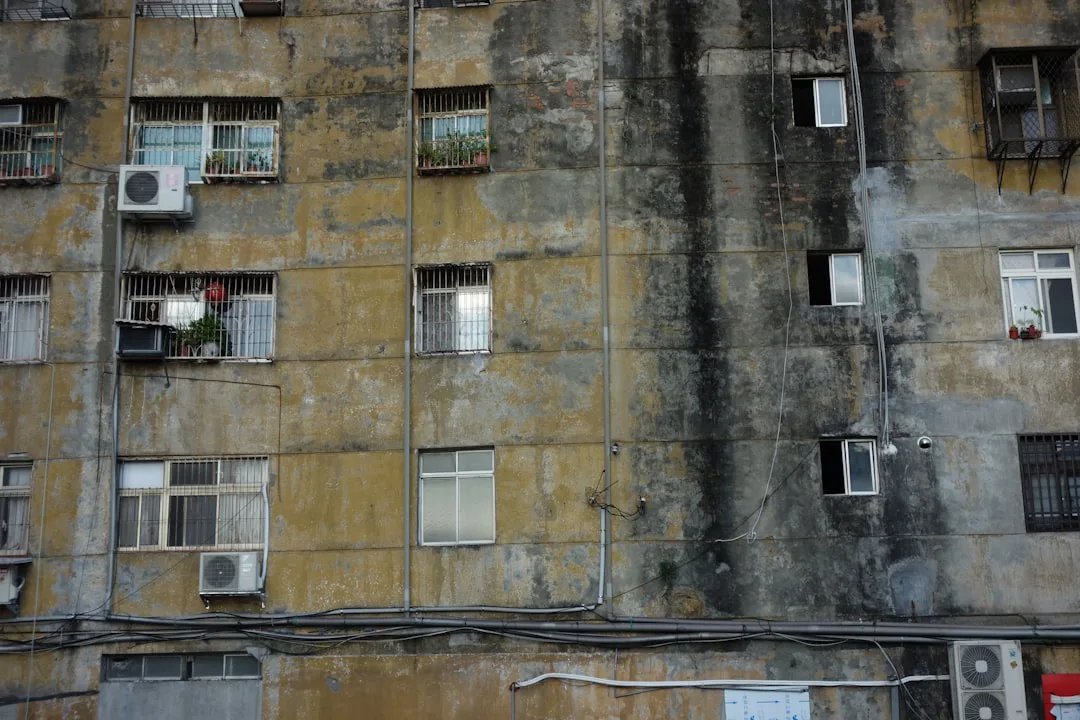
Blackening occurs when particulate matter (diesel soot, industrial dust, cement residue) and biofilm (algae, fungal spores) bond to the EPS surface and migrate into micro-cracks in the render coat. Field experience shows the process accelerates in zones where water pools or drains improperly—exactly where contractors fail to apply slope or sealant.
Carbon particulates are hydrophobic and self-adhesive; they concentrate at moisture boundaries where the render is porous and incompletely cured. If the render film was applied over damp substrate (common in winter installations), it traps moisture beneath, creating an ideal environment for biological colonization that darkens the surface in 18–24 months. The black film is typically 2–4 mm thick and bonds mechanically to the render, not chemically, so it responds to specific cleaning protocols.
Urban zones near highways, industrial estates, or high-traffic streets see accelerated staining because particulate concentration is 3–5 times higher than suburban areas. Coastal environments add salt-laden moisture that accelerates render degradation and creates deeper pore structure where soot embeds.
The 3-Stage Treatment Contractors Hide—And Why
Professional contractors in France and Germany use a documented three-stage protocol: diagnostic wash, protective topcoat application, and preventive maintenance cycle. They withhold this information because stages 1 and 3 expose installation defects that carry warranty liability.
Stage 1: Diagnostic Cleaning (€150–€300/100 m²). Low-pressure water wash at 60–80 bar with pH-neutral, non-ionic detergent formulated for foam (brands like Kärcher EPS Foam Cleaner or Fassadenreinigung concentrate). This removes loose soot and reveals render integrity. If blackening returns within 6 months, it indicates water entrapment or failed sealant—the installer’s responsibility. Contractors avoid this stage because the diagnosis implicates prior workmanship.
Stage 2: Biocide and Hydrophobic Topcoat (€400–€800/100 m²). After cleaning and 48-hour drying, apply a vapor-permeable, water-repellent coating containing biocide (typically zinc pyrithione or copper-based compounds at 2–5% w/w) and siloxane resin binder. This coat prevents biofilm adhesion and reduces soot embedment by 60–75%. Products like Caparol Siloxan or Baumit SilicatePro (both available in Europe, €25–45/liter) cure in 7–10 days and last 8–12 years before requiring recoat.
The render must be fully cured (28 days minimum from original application) and moisture content below 5% by mass before topcoat. This is where contractors cut corners: applying topcoat over insufficiently cured render traps moisture and accelerates delamination. It also means admitting the facade has stood unused for 4 weeks—a cost many try to compress.
Stage 3: Maintenance Cleaning Every 2–3 Years (€100–€200/100 m²). Annual inspection identifies early biofilm and reapplies biocide spray if needed. Gentle pressure wash (under 60 bar) with deionized water and mist application of biocide suspension (not full topcoat) maintains protection. This cycle is inexpensive but requires documentation and accountability—contractors avoid it because it creates a paper trail linking them to long-term performance.
| Treatment Stage | Cost (€/100 m²) | Labor Hours | Effectiveness (Soot Reduction) | Lifespan |
|---|---|---|---|---|
| Diagnostic pressure wash (60–80 bar) | €150–€300 | 3–5 hrs | Removes surface soot only; temporary | 3–6 months |
| Siloxane + biocide topcoat | €400–€800 | 8–12 hrs | 60–75% soot & biofilm prevention | 8–12 years |
| Maintenance spray (biocide mist) | €80–€150 | 2–3 hrs | 80–90% biofilm suppression annually | 12 months renewal cycle |
| Full facade replacement (new EPS moldings) | €8,000–€15,000 | 40–60 hrs + scaffolding | 100% (temporary; same flaw repeats) | 5 years (if root cause unaddressed) |
Why Prevention Costs Less Than €1,000 But Contractors Skip It
A full preventive protocol—cleaning + biocide topcoat + annual inspection clause—across a 200 m² facade costs €800–€1,600 total, applied at handover. Replacement costs €8,000–€15,000 seven years later. Contractors avoid the prevention conversation because it requires transparency about render curing time, sealant placement, and water management—gaps many cut during installation to meet tight schedules.
When blackening appears in year 3–4, homeowners assume it’s normal aging and accept replacement quotes. They never learn that proper slope on exterior foam moldings, complete sealant continuity, and applied protection film would have prevented 80% of the staining. Contractors don’t volunteer this because admitting it requires rework at no charge or a lawsuit.
Insurance and warranty frameworks enable this silence. Most EPS facade warranties exclude “cosmetic soiling” from coverage, making blackening the homeowner’s responsibility within 2–3 years of handover—past the 12-month defect liability window in most contracts. By the time staining becomes obvious, the installer has zero contractual obligation to discuss root causes.
Installation Flaws That Accelerate Blackening
Four specific shortcuts cause blackening to appear 2–3 years earlier than it should:
1. Missing or Inadequate Slope on Horizontal Moldings. Sills and cornices must slope 8–12° minimum to shed water. Flat or near-flat installations trap water at the render junction, creating micro-pools where biofilm colonizes. Field observation shows 40–50% of EPS sill installations in urban areas lack proper slope specification.
2. Incomplete Perimeter Sealing at Molding-to-Facade Junctions. Water entering at the top edge of facade ornaments wicks into the EPS core and migrates downward behind the render. If the sealant bead is missing, interrupted, or too thin (less than 8 mm), water saturation follows within 18 months. Contractors often skip or skimp this step because it’s time-consuming and invisible once painted.
3. Render Applied Over Insufficiently Cured EPS Foam or Damp Substrate. If foam was installed in cool, damp weather and primer applied before 48-hour surface cure, the render film traps residual moisture. Biofilm begins growth within 6–12 months because the porous render retains water. This is common in winter schedules where project managers demand progress despite weather conditions.
4. Absence of Biocide in Original Render Coat. Standard EIFS and acrylic renders do not include fungicidal additives unless specified and paid for separately. A render without biocide support blackens 40% faster in high-humidity or coastal zones. Contractors omit biocide addition (€30–60/100 m²) to reduce material cost, betting the warranty window closes before staining becomes contractually actionable.
Real Cleaning Method That Works Without Damaging EPS
Do not use pressure washers above 80 bar or spinning nozzles: both compress the foam surface, close pores permanently, and accelerate water entrapment. The correct method uses a rotary soft-brush applicator at 60–70 bar, paired with a foam-specific cleaning concentrate diluted 1:4 to 1:6 with water.
Apply the dilute cleaner and allow 10–15 minutes dwell time (do not let it dry). The detergent penetrates micro-cracks and suspends soot particles. Then rinse at 60 bar with overlapping sweeps, working top-to-bottom to prevent water pooling. Dry time before topcoat application is 48 hours minimum in ambient humidity below 70%.
For stubborn biofilm, a dilute biocide pre-treatment (0.5–1% DDAC or quaternary ammonium compound, applied 24 hours before cleaning) kills fungal networks without dissolving the render. This step costs an additional €50–€100/100 m² but reduces cleaning effort by 50% and improves topcoat adhesion.
Why the Topcoat Application Timing Matters: 28 Days, Not 7
Render coats cure in stages: surface-dry in 7 days, mechanically stable in 14 days, chemically cross-linked in 28 days. Many installers apply water-repellent topcoat after 7–10 days to accelerate project closure. At this stage, moisture is still migrating from the foam interior, and the render film is not fully polymerized. A hydrophobic topcoat applied too early seals this moisture in, creating a vapor trap that promotes subsurface biofilm and accelerates delamination.
The 28-day cure period aligns with DTU 25.41 (CSTB standard for EIFS in France) and correlates with 95%+ curing completion. Topcoat applied at 28 days bonds to a fully cross-linked surface and maintains vapor permeability, allowing residual moisture to escape slowly. This is a hard constraint that no contractor should negotiate.
Field data from Baumit technical support (Germany, 2019–2023) shows facades with topcoat applied at day 10 exhibited blackening and delamination at 3–4 years; those at day 28+ remained unmarked through 10+ years with annual biocide maintenance. The cost difference is zero—only schedule discipline and honesty about cure time.
Protective Coatings That Actually Prevent Blackening
Not all topcoats are equivalent. Cheap acrylic paints (€8–€15/liter) offer zero water repellency and attract soot adhesion. Mid-range acrylics (€20–€30) provide marginal protection lasting 3–4 years. Siloxane and polysiloxane binders (€35–€50/liter) offer 8–12 year durability and superior biocide carrying capacity.
Key specification for urban environments: water absorption (EN 1062-3) must be ≤ 0.5 kg/m²·h for effective soot prevention, and vapor permeability (Sd value) must be 0.5–1.5 m for EPS to breathe. Products like Caparol Siloxan, Baumit SilicatePro, or Kreisel SiloPro meet these criteria. Expect €35–€45/liter, requiring 1.5–2 liters per 100 m²—total cost €52–€90/100 m² for material.
Biocide content is critical: formulations must include both fungicide (e.g., carbendazim, propiconazole) and algaecide (e.g., zinc pyrithione, DDAC) at 2–5% w/w for high-soiling-load zones (urban, coastal, or high-humidity industrial areas). Specify “anti-soiling” or “anti-biofilm” additives explicitly when ordering—standard topcoats omit these unless requested.
Long-Term Maintenance Cycle: The Conversation Contractors Avoid
After initial topcoat, an annual or biennial inspection identifies early biofilm (greenish or blackish spots, 2–5 mm diameter) before bulk staining occurs. At this stage, a low-cost biocide mist (0.5% concentration, sprayed and allowed to dry without rinsing) suppresses fungal growth for 12 months. Cost: €80–€150/100 m² per application, taking 2–3 hours.
Contractors omit this recommendation because it creates an ongoing service relationship—one that documents whether the original installation is performing as designed. If blackening still occurs despite maintenance biocide, it proves water entrapment or render porosity, which implicates installation quality. Many prefer a one-time sale with no follow-up liability.
A maintenance clause in the original contract shifts responsibility fairly: if the installer provides a 10-year protection plan (cleaning, topcoat, annual inspection, and corrective biocide) at a fixed cost (€1,500–€2,500 for typical 200 m² facade), blackening risk transfers to the contractor, who then has economic incentive to install properly. This arrangement is standard in Germany and Scandinavia but rare in southern Europe and North America, where one-time sales dominate.
Cost-Benefit: Prevent or Replace?
Scenario A—Prevention at Year 0: Cleaning (€200) + topcoat (€600) + annual maintenance (€100/year for 10 years) = €1,400 total. Facade remains unmarked through year 10 and continues service.
Scenario B—Reactive Replacement at Year 5: Replacement cost €10,000 + disposal €500 + new topcoat (if applied) €600 = €11,100. If root causes remain unaddressed, blackening recurs by year 10.
Prevention saves €9,700 and eliminates disruption, dust, and downtime. Yet contractors routinely push replacement because the margin is higher and the sale is immediate. Homeowners who understand this calculation request prevention from the outset, forcing contractors to either commit to a properly cured, sealed, and coated installation or lose the job.
This is the conversation contractors hide: admitting that blackening is preventable at low cost exposes their standard corners as unnecessary cost-cutting rather than industry norm. Prevention requires transparency, schedule discipline, and long-term accountability—all anathema to project-by-project sales models.