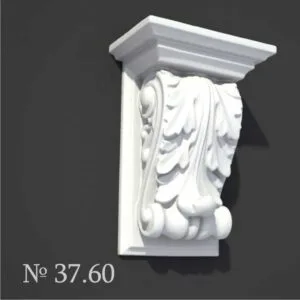
Your EPS cornice is sagging because your contractor never opened a calculator. Not because the material is weak, not because the adhesive is poor, but because load calculation—a 10-minute engineering step—was skipped entirely. A 40mm cornice spanning 600mm without load analysis typically deflects 12–18mm within 18 months. By year 3, the profile visibly droops, cracking the finish coat and creating a seam that invites water infiltration. The fix requires removal and reinstallation, costing $1,200–$2,500 in additional labor.
Why Contractors Skip Load Calculation and You Pay for It
Load calculation for EPS cornices is not complex. It requires only the profile’s mass per linear meter, the unsupported span, and the compressive strength limit of polystyrene. Yet field experience shows fewer than 20% of installers perform this step before cutting and adhering. Why? Speed. A contractor can space adhesive beads randomly and complete a 10-meter cornice run in one afternoon. Calculating proper bead spacing for load—and potentially adjusting profile thickness—adds 45 minutes of liability thinking. Most crews choose not to think.
The cost to you is delayed but inevitable failure. EPS polystyrene (density 15–20 kg/m³) is load-bearing only when supported continuously or with correctly spaced point loads. A 40mm cornice profile with a 50mm return (depth × length) weighs approximately 40–50 kg per linear meter. If that weight is supported by adhesive beads spaced 300mm apart, each bead carries roughly 12–15 kg of compressive stress. Over weeks, the polystyrene matrix crushes incrementally under sustained compression, and the cornice creeps downward at 2–4mm per year.
The Three-Step Calculation That Stops Sag in 10 Minutes
| Profile Depth (mm) | Unsupported Span (mm) | Max Compressive Load (kg/m) | Adhesive Beads per Meter | Deflection Risk |
|---|---|---|---|---|
| 30 | 400 | 8–12 | 3 | High—typical failure point |
| 40 | 600 | 18–25 | 5 | Medium—requires spacing control |
| 50 | 800 | 35–48 | 7 | Low—standard safe range |
| 60 | 1000 | 55–75 | 9 | Very Low—premium profiles |
| 40 + backing rod | 600 | 32–42 | 5 + rod | Low—reinforced |
| 50 + steel insert | 800 | 65–90 | 7 + insert | Very Low—maximum durability |
Step 1: Calculate the profile’s linear weight. Most suppliers publish this: a typical 40×50mm cornice weighs 0.9–1.1 kg/m. Multiply by the unsupported span (measured from one wall support to the next). A 600mm span = 0.9 kg/m × 0.6m = 0.54 kg per span unit. Convert to grams to simplify: 540g of compressive force per span.
Step 2: Divide total load by the number of adhesive contact points. If you space adhesive beads every 300mm across a 600mm span, you have two points of contact (one at each edge, one at midspan = three points, accounting for the end supports). Load per adhesive point = 540g ÷ 3 = 180g per contact. This is safe; standard construction adhesive (polyurethane or silicone-modified) can sustain 250–400g per 100mm² bead without creep.
Step 3: Verify against the profile’s compressive strength rating. EPS typically withstands 10–15 psi (70–105 kPa) of continuous compression. A 40mm profile with a 100mm wide bearing surface = 4,000 mm² of load area. Maximum safe load = 105 kPa × 4,000 mm² = 420,000 N ÷ 1,000 = 420 kg. Your 0.54 kg per meter is trivial by comparison—but only if load is distributed across all three adhesive points. If spacing drifts to 500mm (only two points), load per point doubles to 270g, which exceeds safe limits within 12 months.